






|
Welcome to Michael Dixon Humidors!
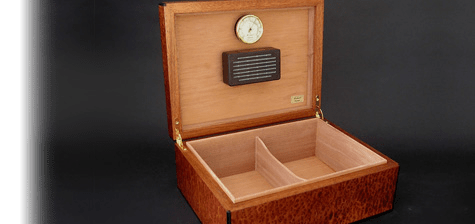
Michael Dixon humidors are offered in sizes to hold from 20 to
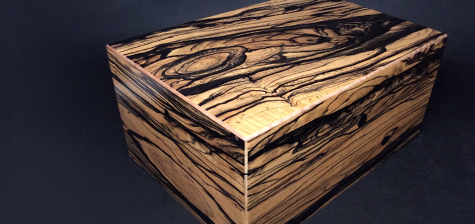
100 cigars. An extensive selection of hardwoods and trim detail ensures
you will find the 'look and feel' that's just right for you.
Available EXCLUSIVELY at Georgetown Tobacco

Discount not valid in Maryland, Virginia and Washington D.C.
MODELS
Specifications for each model are presented below. Click on any model to view a catalog photo
showing greater detail and sample finishes.


Initial
Conditioning
Do
not spray the interior of any humidor with water or apply a damp sponge
or wet rag to any interior wood surface. This will only cause the wood
to expand too rapidly and will raise the grain of the wood thereby giving
it a rough texture. It could also cause the exterior side walls to split
apart and the lid to warp. We will not honor any repair on humidors
that have been over-saturated with water. Please read carefully our
Humigar instruction sheets. Be patient and go slowly while conditioning
the humidor to the 70% R.H. level. It is a slow process and needs to
be done slowly so the box can acclimate to the higher humidity levels.
Tight
fit/Loose fit
There
are conflicting thoughts in the marketplace as to how a lid should fit
down over the raised cedar interior lining. Some feel the lid should
fit snugly or air-tight when closing thereby giving the interior an
air-tight seal. Others feel a humidor should “breathe” and
that the moisture should be allowed to escape so there is an air exchange.
Stagnant moist air will harbor bacteria which will create mold. Mold
will ruin cigars within 1-2 days if left unnoticed. We purposely leave
a 1/64” recess on the interior lining so as to allow a small amount
of air exchange. This way the interiors are allowed to breathe somewhat,
allowing a small amount of air exchange.
Solid
Wood vs. Veneer Construction
There
are two methods of constructing humidors. For the casual observer it
is sometimes difficult to perceive the difference in the two types of
construction. So we will point out how to tell the difference and the
advantages and disadvantages of both methods.
The
first method is the veneer over fiberboard method. Fiberboard is used
extensively in kitchen cabinet construction. If you have a Formica counter
top, chances are it is glued onto medium density fiberboard or MDF.
MDF is a combination of sawdust, glue and resins. It is man-made and
is very stable under dry conditions. However, it expands easily and
rapidly if it gets wet. Veneer over MDF is used almost exclusively by
the European humidor builders. This is due mostly to the availability
in Europe of veneers rather than solid hardwoods. Also historically
the Europeans have always favored veneer construction over solid woods
in their furniture due to the extreme expense in obtaining solid hardwoods.
European forests do not yield the variety of woods of the American forests.
Walnut, Cherry, Red Oak, Maple and many other hardwoods are exclusively
native American and grow typically in the eastern forests of the U.S.
Since the veneers used are very thin, they are not easy to sand. Special
care must be taken when sanding in order to avoid sanding through the
veneers and into the MDF base material. In order to avoid this problem
many coats of dense polyester or epoxy type finish are applied over
the raw veneers. Once the finish has been built up to a sufficient thickness,
it is sanded smooth, top coats are applied, and the final coat is buffed
to a high gloss. This method has the advantage of protecting the veneers
but the distinct disadvantage of cost as it is very labor intensive.
The final product has a wet/gloss look and is very contemporary. Therefore
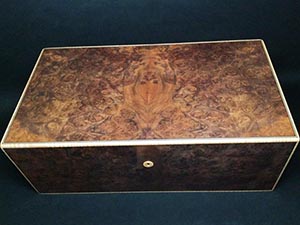
the tell-tale sign of a veneer/MDF humidor is the high gloss look and
most often with a distinct wood trim around the outside borders to hide
the veneer lines.
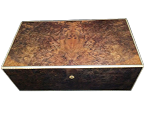
The second method is the sawn veneer construction. This method involves sawing lumber into 1/8" thick veneers and overlaying them onto the sides and top of humidors. The unseen interior sides are laminated MDF and solid hardwoods to match the outside veneers. This method is similar to the first, only it does not require edge binding to hide the veneer edges and does not require a high gloss finish. We use this method on all of our humidors with the following woods: Bubinga-#70, Cherry-#72, Lacewood-#73, Curly Maple-#76, Quilted Maple-#87, and Rosewood-#86.
Bottom
Construction - Recessed Vs. Flush
There
are two methods of constructing the bottom of a humidor or any box for
that matter. The first is a flush bottom method which is flat on the
bottom. Most boxes use plywood for the bottom. A flush bottom has to
be fitted and stapled and glued into place so it won’t come out.
However, this method has two distinct disadvantages. If the plywood
bows or warps, the bottom will become curved and will not sit flat on
a flat surface. Also it is structurally weak compared to the recessed/drawer
bottom method. You could actually punch out the bottom of a box with
your fist or a hammer as the plywood is only attached to a very small
area of the side walls.
The
second method is the recessed method whereby the plywood bottom is recessed
into a locking dado groove usually ¼” above the bottom
surface. Most drawer bottoms are constructed in this manner. It is a
much stronger method and will not be affected by a warped plywood bottom.
We use this recessed method.
Spanish
Cedar vs. Substitute Woods
Spanish Cedar has been used during this century and the last for cigar
box construction. It has always been the wood of choice for curing and
aging cigars. Perhaps the aroma of Cedar blends with the tobacco and
helps to enhance its aroma. It is definitely a tradition that is steeped
in the history of cigar making itself. Perhaps one of the reasons it
was used initially was because of its availability at the time. It is
a dominant Latin American species and literally grows in all countries
from Mexico to Chile. The only exception is Argentina which is too temperate
to sustain its growth cycle. In any event it is still preferred by cigar
manufacturers. During the aging and curing process of the leaves (aging)
and finished cigars (curing) Cedar is used in the storage containers
and warehouse interior walls.
Therefore
we feel that Cedar should be used as well in our humidors but not exclusively.
Cedar has a tendency to bleed a sap gum resin when exposed to heat.
This gummy resin is actually inside the wood itself and may not surface
for several months. So in order to avoid this potential problem, we
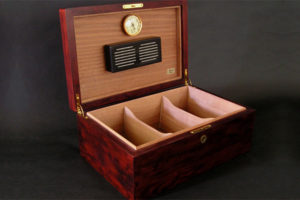
use another wood - Sapele - in conjunction with the Cedar. This gives
us the best of both woods so-to-speak. We use the Cedar in veneer form
only on the top and bottom interior surfaces and Sapele on the interior
wall lining. Sapele is also much denser than Cedar and more stable.
Thus, it is a much better wood to use for the interior walls and protruding
lip.
Hygrometers
- Digital vs. Dial
There
are two types of hygrometers on the market today - digital and dial.
Both have advantages and disadvantages. Dial types are more attractive
and most often less expensive but less accurate as they have to be calibrated
or reset periodically (much like adjusting bathroom scales). Digital
types are less attractive and seldom used by humidor makers, but are
more accurate and do not need to be reset. They are most often sold
as an after market item and are more expensive than the dial types.
The
main problem with hygrometers is not the hygrometer itself but what
it is reading or measuring. Relative humidity is not a constant. It
varies from one day to the next, one hour to the next, one minute to
the next, and from one side of a room to the other. Think of humidity
as a cloud that is full of floating moisture. Much like the clouds outside,
it is constantly changing, moving, evaporating and absorbing moisture.
Any attempt to measure this moving entity is almost impossible. So we
have to settle for a range effect and not an exact percentage. Inside
a cigar humidor moisture will always be the greatest directly under
the moisturizer and least the furthest away. If there is a tray blocking
the movement of the moisture, then the R.H. could be 70% on the top
and 50-60% on the bottom; simply because moisture falls as it does from
the sky in the form of rain. So even though your hygrometer is reading
exactly 70% - don’t trust it - digital or dial.
The
best test is to pinch your cigars. The old pinch test will tell you
immediately which cigars are okay and which ones are too dry. Use your
hygrometer as an indicator of the range of humidity and try to keep
it at the 70% mark. If you still have dry cigars, place them directly
under the moisturizer to rejuvenate them.
Cigar
Moisturizers - A Brief History
When
the cigar boom hit there was only one supplier of cigar moisturizers
- an outfit in France called Credo. They were a small operation with
only a few employees and suddenly overnight they were an international
supplier to both retail tobacconists and humidor makers. They had a
tough time keeping everyone happy and in addition they only dealt with
one U.S. importer/distributor in L.A. who wasn’t really interested
in selling moisturizers. So they expanded production but by the time
they did so, it was too late. Cigar moisturizer makers started popping
up left and right in 1997 and today there are by most accounts 5-10
of them alone in the U.S. all claiming theirs to be the best, cheapest,
maintenance free, etc., etc. We got into the picture as well because
we could not obtain nor really wanted to pay the exorbitant price for
the Credo units. So it forced us to come up with our own moisturizer
which we dubbed the Humigar. Soon word got out that our units were superior
to the Credos. They were larger in size and thus held more water for
longer periods of time, had much stronger magnets, were available in
a variety of colors, used netting to prevent foam flaking and were less
expensive than the Credos. That was 1996. By 1997 the deluge hit as
it did with all cigar related products. Everyone had the newest, best,
longest-lasting-between-refill moisturizers. The hype was superfluous
and beyond reason - especially for an item that basically just evaporates
moisture - not rocket science here and not high tech automobile hoopla
although it definitely resembled it.
In
any event that is the history of the product. The bottom line is if
it works, use it. If not, throw it away and get one that does.
Hinges
and Hardware
Probably
the most frustrating part of making fine quality boxes whether jewelry
boxes, silverware boxes, humidors, etc. is finding good quality hinges
and hardware ( lock and key sets) to compliment the quality of the box.
There is plenty of junk hardware on the market both from Asia and Europe.
There is only one maker in the U.S. that makes good quality solid brass
hardware. But guess what: his designs are bad - old fashioned butt hinges
- and he offers no plating or protective finish to keep the brass from
tarnishing! Common sense will tell you that any raw brass product will
tarnish over a short period of time. So almost all brass products are
plated with a gold color to protect the brass and prevent it from tarnishing.
Brass horns, brass beds, urns, candlesticks and all brass products are
always plated.
So
we again had to design and make our own hinges and hardware using solid
brass with gold plating and epoxy finish to protect the gold plating.
And we did not use the thin stamped-out hinges as seen on European humidors
but chose to use the thicker (1/8” thick) brass stock and mill
them to size with computerized milling machines (CNC). Because we designed
them this way, we have the best hardware of any humidor on the market
today.
Trays and Why They Don't Work
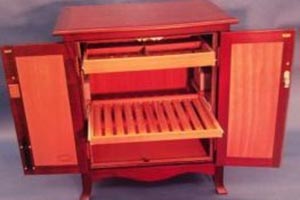
It is very logical why trays do not work in humidors. They prevent the flow of moisture from falling evenly on the cigars below the tray and they over-saturate the cigars in the tray that sits immediately below the moisturizer. If you removed the cigars from the tray and allow the moisture to flow through the bottom vents, you have defeated the purpose of the tray! So why bother. Exactly. Don't be duped by humidors with trays, especially the large flashy European brands. They are all show and no go.
| Hardwoods
Bubinga
Cherry
Lacewood
Curly Maple
Quilted Maple
Indian Rosewood
Brazilian Rosewood
Quilted Cherry
Lightning Bolt Movingue
Curly Claro Walnut
Vavona Burl
Pommele Bubinga
Macassar Ebony
Mottled Makore
Curly Koa
Curly Ovangol
|
Trims
Curly Maple
Ebony
|
|